Winning through leverage
If you follow European soccer, you would have been familiar with Lionel Messi’s record-breaking rankings long before the 2022 World Cup when Argentina won the title and Messi was recognized across the world as the GOAT, the greatest of all time.
When he was just 24, he broke the record for all-time goals at his club, Barcelona, ten years before the 2022 World Cup.
At age 27, he broke the record for all-time assists.
By age 35, Messi broke the record for number of goals scored in all of Europe.
When he was younger, Messi’s competitive advantage was in his explosive acceleration and relentless dribbling.
As he aged, he shifted his strategy and became known for walking the field.
He wasn’t maximizing movement, he was maximizing impact.
He chose his moments to accelerate.
He played deeper as a playmaker to orchestrate the entire team’s attack.
He used vision and passing more than constant attacking.

Picture by Franco Monsalvo in Pexels
This shift is common in older athletes.
Michael Jordan was known for his explosive dunks, constant drives and athletic dominance when he was younger.
As he aged, he shifted from athleticism to precision, and was known as a fadeaway jumper, reading defenders and for tempo control. He famously said he learned he didn’t have to outrun everyone anymore.
Young LeBron James was relentless in transition offense and bulldozing to the rim.
Current LeBron conserves energy, controls pace, quarterbacks the offense, and picks his moments. He moved from force to orchestration.
Over time, Tim Duncan became less explosive, but more efficient through better positioning, better angles, communication, and leadership.
There are examples of this in every sport, but it doesn’t end there.
Musicians do this too, transitioning from technical virtuosity to emotional expression.
Chess players evolve from relying heavily on calculation speed to emphasizing opening preparation, strategic understanding, and psychological insight.
Professionals in a variety of fields, from medicine to aviation to military leadership, learn to anticipate problems earlier, avoid situations that require heroic reactions, and reduce workload through planning.
Here is the shift that happens, across any field:
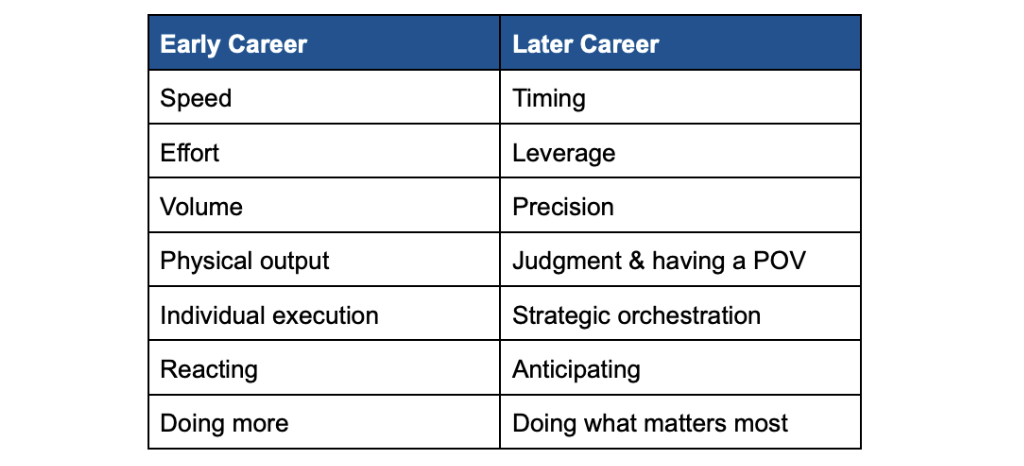
The highest levels of mastery are characterized not by working harder, but by increasing the ratio of impact to effort.
Work becomes effortless while the impact is outsized.
It is a force multiplier.
The successful professionals learn how to evolve their strategic advantage over time and capitalize on what they are uniquely suited to do.
They’ve mastered the human skills of good judgment, specialized knowledge, and the ability to collaborate and coach.
They have decades of organizational experience and know what works and what doesn’t.
They know what uniquely drives outcomes and double down on high-return activities.
They move away from linear output toward leveraged impact.
They anticipate obstacles to success and actively work to mitigate them.
They are winning through leverage.
If you would like to evolve your strategic advantage at work and increase your effort to impact, we should have a conversation.
Love,
Audrey